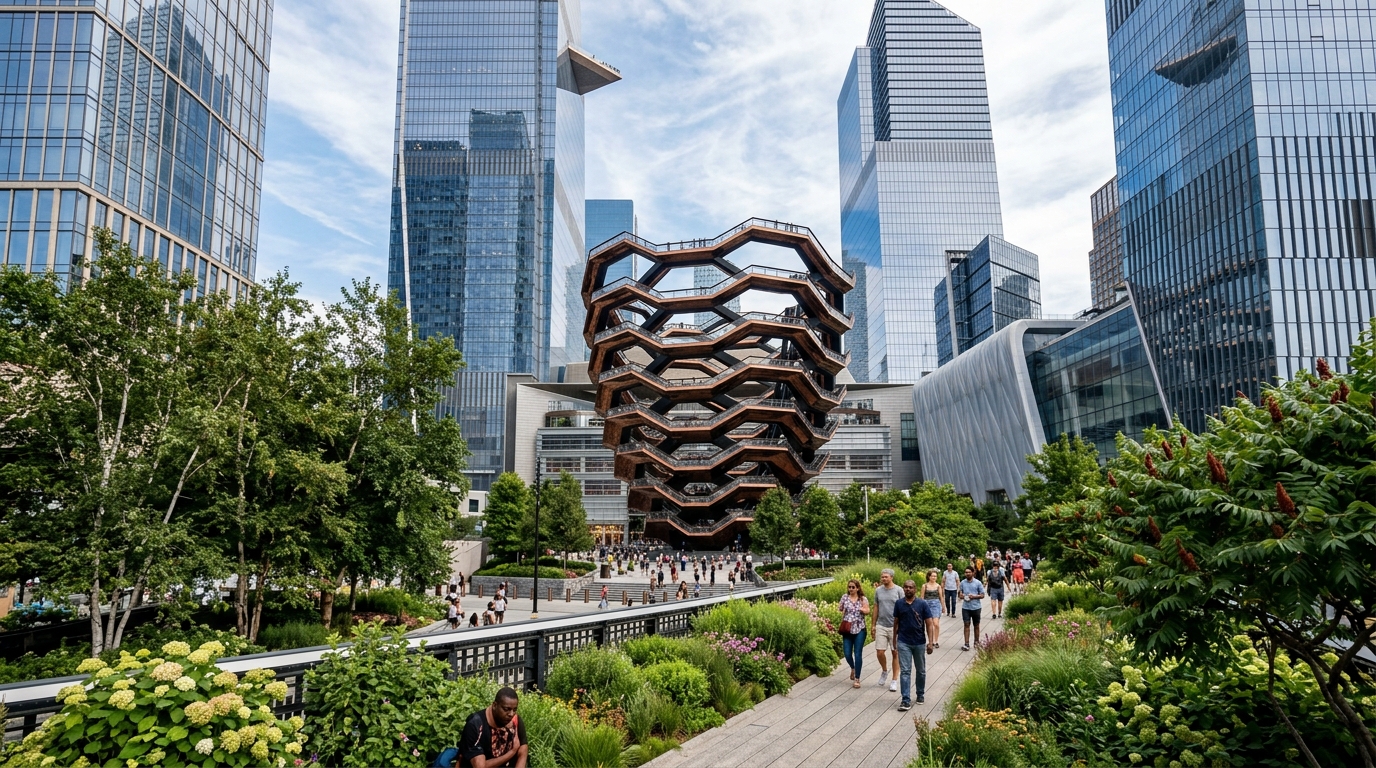
Introduction: The Architectural Rebirth of Manhattan’s Far West Side
For more than a century, the far western flank of Midtown Manhattan between 30th and 34th Streets was a gritty, industrial labyrinth of active rail yards, freight shipping docks, cold-storage warehouses, and elevated train viaducts. Today, this twenty-eight-acre waterfront parcel has undergone the most radical, ambitious urban transformation in modern North American history. Anchoring this new skyline is Hudson Yards—a $25 billion master-planned neighborhood that represents the largest private real estate development in American history—seamlessly connected to The High Line, an internationally celebrated 1.45-mile elevated linear park transformed from an abandoned 1930s industrial freight viaduct.
Together, Hudson Yards and The High Line represent the pinnacle of modern architectural engineering, sustainable urban design, and public art. Here, visitors encounter Thomas Heatherwick’s monumental bronze honeycomb sculpture The Vessel; Edge, the highest outdoor observation sky deck in the Western Hemisphere rising 1,100 feet above the pavement; The Shed, an innovative telescopic cultural center on monumental steel wheels; and a soaring forest of sustainable glass supertall towers designed by visionary architects like Kohn Pedersen Fox, Diller Scofidio + Renfro, and Bjarke Ingels. Yet navigating this vast, multi-level modern district on foot can be challenging. An expertly coordinated private chauffeured excursion with Tour to NYC Tours provides effortless curbside staging along the West Side Highway and 10th Avenue, allowing visitors to explore the elevated park in distinct sections without walking miles in direct afternoon sun.
In this comprehensive architectural guide, we unpack the extraordinary platform engineering beneath Hudson Yards, trace the botanical and historical journey of The High Line, highlight observation decks and cultural institutions, and explain how a private chauffeured tour delivers the ultimate West Side experience.
The Engineering Miracle: Building a Modern City on an Active Rail Platform
To comprehend the grandeur of Hudson Yards, one must understand what lies beneath the surface. The entire development does not rest on solid Manhattan schist bedrock. Instead, it is suspended directly above thirty active commuter rail tracks of the Long Island Rail Road (LIRR) and Amtrak’s Northeast Corridor tunnels feeding into Pennsylvania Station. To construct skyscrapers weighing hundreds of thousands of tons without interrupting a single commuter train, structural engineers executed an engineering triumph:
- The 10-Acre Steel & Concrete Platform: Engineers drilled more than 300 massive caissons deep between active rail tracks, anchoring into bedrock. Across these columns, a monumental platform comprising 25,000 tons of structural steel and 14,000 cubic yards of concrete was constructed, acting as an artificial ground plane capable of supporting multiple 1,000-foot skyscrapers.
- Jet Engine Cooling & Heat Dissipation: The active rail yard beneath the platform generates intense heat from idling diesel and electric locomotives. A massive mechanical ventilation system featuring fifteen high-velocity jet fans circulates over two million cubic feet of fresh air per minute, preventing underground temperatures from exceeding 150°F and protecting building foundations.
- Smart Soil & Roots Cooling: To ensure that the five-acre public square’s 28,000 trees, shrubs, and perennials thrive above the heated rail yards, landscape architects engineered specialized layered soil beds cooled by closed-loop chilled water pipes and sub-surface irrigation systems that collect and recycle 10 million gallons of stormwater annually.
The Architectural Icons of Hudson Yards
1. The Vessel (Thomas Heatherwick Studio)
Rising 150 feet above the central plaza like a monumental bronze honeycomb, The Vessel is an extraordinary interactive public landmark designed by British visionary Thomas Heatherwick. Constructed from 154 intricately interconnecting flights of stairs, 2,500 individual steps, and 80 geometric viewing landings, the copper-colored structural steel pavilion reflects the surrounding skyscrapers and sky. Walking inside creates a dizzying, kaleidoscopic architectural perspective that redefines public sculpture.
2. Edge NYC: The Highest Outdoor Sky Deck in the Western Hemisphere
Cantilevering eighty feet outward from the 100th floor of 30 Hudson Yards (a 1,296-foot skyscraper designed by Kohn Pedersen Fox), Edge is an adrenaline-fueled observation deck rising 1,100 feet in the sky. Featuring a 225-square-foot glass floor through which visitors can gaze straight down at the miniature street traffic below, and nine-foot glass walls angled outward at a 6.6-degree pitch, Edge allows thrill-seekers to lean out over Manhattan with unobstructed horizon views stretching from the Statue of Liberty to Central Park. For extreme adventurers, ‘City Climb’ allows harnessed climbers to scale the exterior crown of the skyscraper at 1,271 feet.
3. The Shed (Diller Scofidio + Renfro & Rockwell Group)
Adjacent to 15 Hudson Yards stands The Shed, New York’s revolutionary cultural institution dedicated to commissioning and producing original performing arts, visual arts, and pop culture. Its signature feature is an extraordinary 120-foot movable outer shell constructed of an ethylene tetrafluoroethylene (ETFE) lightweight polymer facade. Resting on eight massive steel crane wheels (each six feet in diameter), the 4,040-ton shell can roll forward on tracks in just five minutes, enclosing a 17,000-square-foot light-, sound-, and temperature-controlled indoor auditorium called ‘The McCourt’.
4. The Commercial Supertalls: 10, 30 & 50 Hudson Yards
Hudson Yards features some of the most energy-efficient, sustainable commercial skyscrapers on earth. 30 Hudson Yards serves as the global headquarters for WarnerMedia and KKR. 10 Hudson Yards, designed with dramatic sloping angular facets that cantilever over the High Line, houses Coach and L’Oreal. 50 Hudson Yards, standing 981 feet tall, is the fourth-largest commercial office tower in New York, housing global financial titan BlackRock and Meta.
| Landmark / Structure | Lead Architect | Height / Length | Engineering Marvel |
|---|---|---|---|
| The High Line | James Corner Field Operations & Diller Scofidio | 1.45 Miles Linear | Repurposed 1934 elevated freight viaduct |
| The Vessel | Thomas Heatherwick Studio | 150 Feet / 16 Stories | 2,500 interlocking steps & 80 landings |
| Edge Observation Deck | Kohn Pedersen Fox Associates (KPF) | 1,100 Feet (100th Floor) | 80-foot cantilever & glass viewing floor |
| The Shed | Diller Scofidio + Renfro & Rockwell Group | 120 Feet High | 4,040-ton movable shell on rail wheels |
| The Spiral (66 Hudson Blvd) | BIG – Bjarke Ingels Group | 1,031 Feet (66 Stories) | Continuous spiraling outdoor landscaped terraces |
The High Line: Industrial Relic to World-Famous Linear Park
Directly intersecting Hudson Yards at 30th Street is The High Line. Built in 1934 by the New York Central Railroad as part of the West Side Improvement project, the elevated viaduct originally transported millions of tons of freight trains—delivering meat, poultry, and dairy directly into Upper West Side industrial buildings—eliminating deadly street-level train collisions along Tenth Avenue (famously nicknamed ‘Death Avenue’). After freight operations ceased in 1980, the viaduct was slated for demolition until community visionaries Robert Hammond and Joshua David founded ‘Friends of the High Line’ in 1999 to preserve it as an elevated public sanctuary.
1. Piet Oudolf’s Naturalistic Landscape Design
Dutch landscape designer Piet Oudolf transformed the disused railway tracks into a living tapestry of wild, perennial beauty. Inspired by the self-seeded wild grasses, birch trees, and wildflowers that grew naturally on the abandoned tracks for two decades, Oudolf integrated original steel rail tracks directly into tapering concrete walking planks (‘peel-up’ pavers), allowing prairie grasses, coneflowers, sumac trees, and switchgrass to sprout organically through the pavers.
2. The 10th Avenue Square & Overlook (17th Street)
At 17th Street, the High Line widens into an amphitheater-style sunken seating arena positioned directly above Tenth Avenue. Large glass viewing windows allow visitors to sit and watch the yellow taxicab traffic flow beneath their feet, creating an urban theater of street life.
3. The Chelsea Market Passage & Spur
Between 15th and 16th Streets, the High Line passes directly through the former National Biscuit Company (Nabisco) factory complex—the historic birthplace of the Oreo cookie in 1912, now home to Chelsea Market. Today, open-air food kiosks, art installations, and historical bronze plaques line the covered industrial concourse.
The Impossible Engineering Feat: Building Hudson Yards Above Active Rail Yards
To truly appreciate the architectural achievement of Hudson Yards, one must look downward into the subterranean infrastructure beneath the gleaming granite plazas. Unlike conventional skyscrapers anchored deep into virgin bedrock, the entirety of Hudson Yards Eastern Yard—including the residential towers, retail pavilions, public gardens, and the 150-foot Vessel—floats on an engineered steel and concrete platform suspended above thirty active Long Island Rail Road (LIRR) train storage tracks and three subterranean Amtrak and New Jersey Transit rail tunnels connecting to Penn Station.
- 300 Deep-Caisson Foundations: To support the crushing weight of multiple supertall skyscrapers without interrupting a single commuter train schedule, structural engineers drove nearly 300 massive caissons up to 120 feet deep into Manhattan schist bedrock between active electrified tracks. Work was performed during brief overnight four-hour maintenance windows, maneuvering steel trusses weighing up to 200 tons around 12,000-volt overhead catenary wires.
- The Thermal Cooling Deck: Directly beneath the planted public gardens of Hudson Yards lies a sophisticated engineered ceiling that acts as a heat shield. Because hundreds of diesel and electric train locomotives idle in the rail yards beneath, generating temperatures exceeding 150 degrees Fahrenheit, the underside of the platform is equipped with industrial jet ventilation fans, massive thermal insulation slabs, and specialized soil cooling tubing to prevent the roots of over 28,000 public trees and plants from baking.
- The Shed’s Kinetic Engineering: Adjacent to 15 Hudson Yards stands The Shed, a groundbreaking 200,000-square-foot multi-arts center designed by Diller Scofidio + Renfro in collaboration with Rockwell Group. The Shed’s most celebrated engineering feature is an 8-million-pound telescoping outer shell made of lightweight translucent ETFE (ethylene tetrafluoroethylene) panels that rolls on six-foot-diameter double-flanged steel bogie wheels along industrial crane tracks. Powered by six 15-horsepower motors (less energy than a standard minivan engine), the shell deploys in five minutes, transforming the open outdoor plaza into a 17,000-square-foot light- and sound-controlled performance hall.
From Industrial Viaduct to Botanical Icon: The High Line’s Horticultural Secrets
While millions of visitors marvel at the elevated skyline views from The High Line, the park is equally renowned among landscape architects as a triumph of contemporary ecological design. Created through a historic collaboration between landscape architecture firm James Corner Field Operations, design studio Diller Scofidio + Renfro, and master Dutch horticulturist Piet Oudolf, the park showcases an innovative ‘wild naturalism’ inspired by the self-seeded wild perennials and trees that colonized the abandoned railroad tracks between 1980 and 2000.
- Native & Self-Sustaining Flora: Oudolf selected over 500 species of perennial grasses, wild shrubs, and indigenous trees chosen for hardiness, drought tolerance, and seasonal textural shifts. In spring, delicate serviceberry blossoms and wild chives burst into bloom; in autumn, fiery amber prairie grasses and crimson sumac mirror Manhattan’s golden sunsets; in winter, dried seed heads and architectural birch bark create a serene sculptural landscape against modern glass skyscrapers.
- Pioneering ‘Agri-Tecture’ Paving: To evoke the gradual reclamation of the rail tracks by nature, the design team invented custom tapered concrete pavers known as ‘peel-up’ planks. Instead of rigid borders, the paving planks interlock with open planting joints, allowing creeping thyme, sedum, and wild moss to sprout naturally between pedestrians’ footsteps while channeling 100 percent of stormwater runoff directly into the soil beds below.
- Connecting to Little Island at Pier 55: Strolling south toward the High Line’s southern terminus at Gansevoort Street, visitors encounter an extraordinary visual dialogue with Little Island—a 2.4-acre public park floating in the Hudson River designed by Thomas Heatherwick. Rising from the historic pier pylons where the RMS Carpathia delivered survivors of the Titanic in 1912, Little Island is supported by 132 whimsical tulip-shaped concrete pots holding undulating hills, rolling lawns, and a 687-seat waterfront amphitheater.
The VIP Advantage: Combining the West Side with a Private Chauffeur
Because The High Line is a 1.45-mile elevated pedestrian park with stairs and elevators located only every few blocks, exploring it on foot can lead to backtracking and exhaustion in summer heat or winter winds. A private chauffeured vehicle with Tour to NYC provides the ultimate seamless solution:
- Effortless Sectional Drop-Offs: Your chauffeur drops you at Gansevoort Street in the Meatpacking District to walk the southern garden spur, meets you at 23rd Street to avoid the mid-park crowds, and shuttles your party directly to the VIP entrance of Edge and Hudson Yards.
- Secure Storage for Shopping & Dining Bags: After browsing luxury flagships at The Shops at Hudson Yards or buying artisanal treats at Chelsea Market, your bags remain securely locked in your vehicle trunk.
- West Side Highway Highway Express: Seamlessly transition from modern architecture at Hudson Yards down to historic Lower Manhattan or across to Central Park via the West Side Highway in a peaceful, climate-controlled leather cabin.
Frequently Asked Questions on Hudson Yards & The High Line
Is admission to The High Line free?
Yes. The High Line is an official public park operated in partnership with the NYC Department of Parks & Recreation and Friends of the High Line, and general access is completely free of charge.
Do you need tickets for Edge observation deck?
Yes. Edge requires timed-entry admission tickets. We strongly recommend booking sunset admission slots several weeks in advance to experience the transition from golden hour daylight to illuminated night skyline.
Is the entire High Line wheelchair and stroller accessible?
Yes. The High Line features multiple ADA-accessible passenger elevators and street-level access ramps located at Gansevoort Street, 14th Street, 23rd Street, 30th Street, and 34th Street.
Conclusion: Witness the Bold Future of Manhattan Architecture
Hudson Yards and The High Line represent the audacity, visionary engineering, and boundless reinvention of New York City. Experience this modern wonder with supreme ease, elegance, and insight by partnering with Tour to NYC.
Reserve your private architectural sightseeing tour at Tour to NYC Tours or consult with our tour coordinators at Tour to NYC Contact today.